
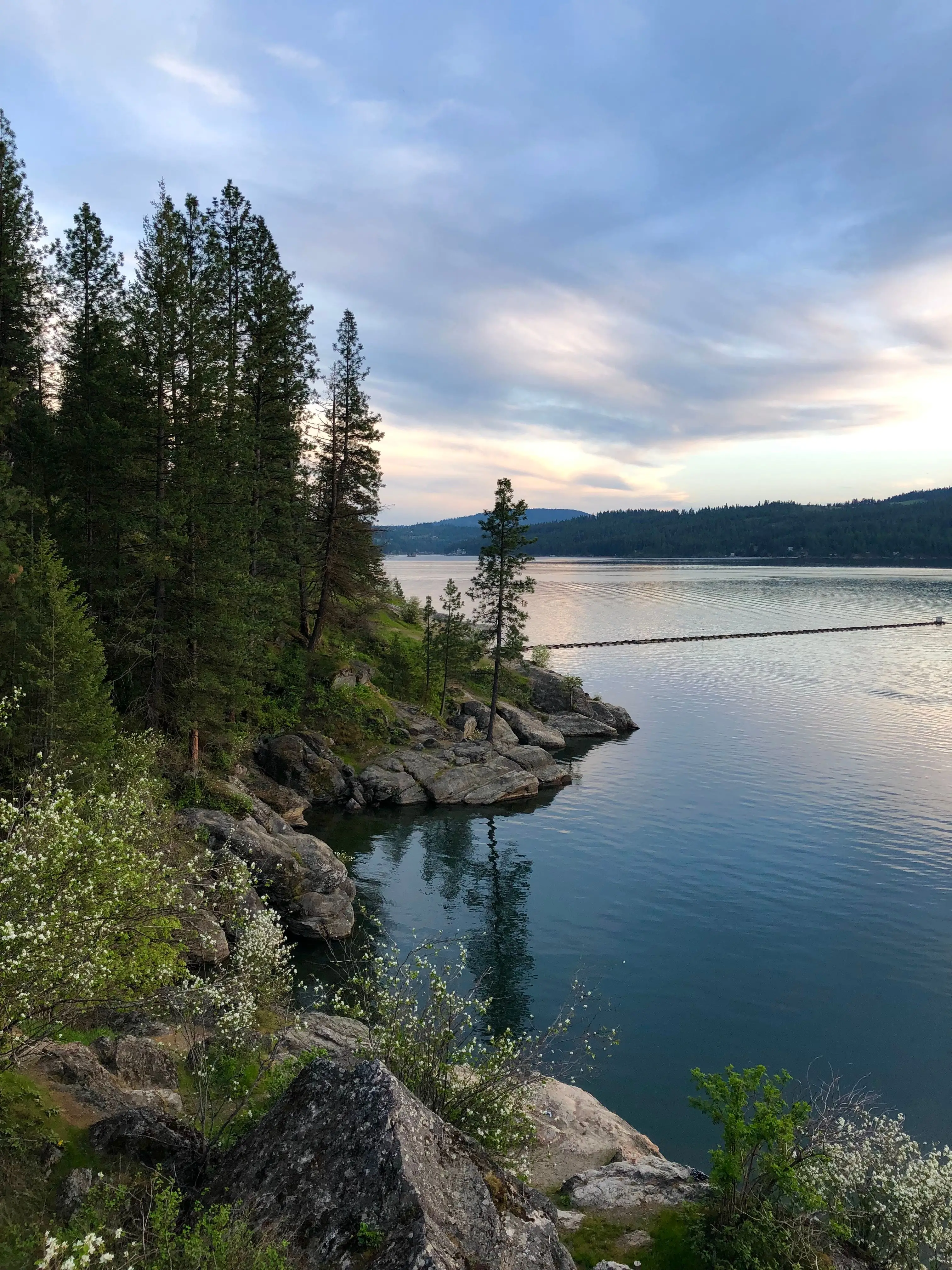
There are places we pass so often that it is easy to forget how many stories they hold. A familiar trail was once part of a very different shoreline. A city park remembers an amusement pier filled with summer crowds. A quiet rock beside the Spokane River marks an agreement made more than a century ago. Across Coeur d’Alene and the surrounding communities, history is not confined to museums. It remains woven into the places where we walk, gather and enjoy North Idaho today.
Before Coeur d’Alene Was A City
Long before streets, resorts and waterfront parks defined modern Coeur d’Alene, this landscape was home to the Schitsu’umsh, or Coeur d’Alene Tribe. Their ancestral homeland extended across a broad region of what is now North Idaho, eastern Washington and western Montana, with lakes, rivers and forests shaping daily life and culture.
The name Coeur d’Alene arrived much later. French-speaking fur traders used the phrase, meaning “heart of an awl,” in reference to the trading abilities of the Coeur d’Alene people. As European settlement expanded throughout the Inland Northwest, the lake and the community that developed along its shore eventually adopted the name.
Many of the places that now seem inseparable from Coeur d’Alene grew from the dramatic changes of the late 19th and early 20th centuries, when military activity, mining, timber, railroads, tourism and hydroelectric power began reshaping the region.
Fort Sherman: Where A Town Begins To Take Shape
One of the most important chapters in Coeur d’Alene’s development began with a military post.
Camp Coeur d’Alene was established in 1878 on the lake near the mouth of the Spokane River. It was later renamed Fort Sherman in honor of General William Tecumseh Sherman. Around the post, a civilian community began to develop, helping establish the foundations of the city that followed.
The fort closed near the end of the 19th century, but traces of it remain. One of the most recognizable is the Fort Sherman Chapel, built in 1880 and still standing today. The former fort grounds eventually became part of the campus of North Idaho College and the surrounding neighborhood.
It is an interesting transformation to consider. A place established for military purposes gradually became part of an educational and residential setting, while preserving pieces of the community’s earliest built history.

Treaty Rock
Carved into stone beside the Spokane River, Treaty Rock preserves the story of an agreement between Frederick Post and Coeur d’Alene tribal leadership, marking a pivotal period in the early history of what would become Post Falls.
Tubbs Hill: The Landmark That Stayed Wild
Few places are as closely associated with Coeur d’Alene today as Tubbs Hill. The wooded peninsula rises immediately beside downtown, creating the unusual experience of stepping from city streets onto forested trails overlooking Lake Coeur d’Alene within minutes. Yet its present character was not inevitable.
The hill takes its name from Tony Tubbs, an early Coeur d’Alene resident who acquired property there in the late 1800s. Over the decades, ideas for development came and went, but community efforts ultimately helped preserve the land for public use.
Today, Tubbs Hill encompasses more than 100 acres of publicly accessible natural space. Its trails, rocky shoreline, beaches and lake views have become part of everyday life in Coeur d’Alene.
Its history is perhaps most meaningful because of what did not happen. In a downtown that changed dramatically around it, Tubbs Hill remained largely natural, giving generations of residents and visitors access to the same forested shoreline.
Playland Pier: When The Waterfront Had A Roller Coaster
Today, City Park and the beach are places for swimming, picnics, concerts and leisurely summer afternoons. There was a time, however, when this stretch of waterfront offered a very different kind of entertainment.
Playland Pier opened in the 1940s and became a beloved summer attraction for roughly three decades. Built along the Coeur d’Alene waterfront, the amusement park featured rides, games and the sights and sounds associated with a classic mid-century summer destination.
Its attractions changed over the years, but Playland Pier became part of the childhood memories of generations of local families and summer visitors.
The amusement park eventually closed in the 1970s, and the waterfront continued its evolution into the public recreation area familiar today.
Knowing that history changes the way one sees City Park. The shoreline may be quieter now, but beneath today’s lawns, beaches and pathways is the memory of an era when families came downtown for carnival rides and evenings on the pier.
The Coeur d’Alene Resort And A Waterfront Reinvented
The downtown waterfront changed again dramatically during the 20th century.
Before The Coeur d’Alene Resort became one of the city’s most recognizable landmarks, the site had a long association with hospitality. The historic Hotel Coeur d’Alene once stood near this location, welcoming travelers during an era when railroads, steamships and growing tourism were changing the region.
The modern Coeur d’Alene Resort emerged in the 1980s and helped usher in a new chapter for downtown tourism. Its development transformed the lakefront and strengthened Coeur d’Alene’s identity as a destination centered around the lake.
Over time, the resort became closely connected with boating, dining, golf and the visitor experience, including the well-known floating green at the Coeur d’Alene Resort Golf Course.
The story of the site reflects a recurring theme in local history: the lake has continually shaped how Coeur d’Alene grows, welcomes visitors and imagines its future.
Treaty Rock: History Written In Stone
A short drive west, Post Falls holds one of the region’s more unusual historic landmarks.
Treaty Rock sits near the Spokane River and bears an inscription connected with Frederick Post, the German immigrant for whom Post Falls was named, and Coeur d’Alene tribal leadership.
Post established a mill along the river in the 1870s. The agreement associated with Treaty Rock concerned his use of land near the Spokane River and falls. An inscription carved into the stone became a physical reminder of that encounter and the complicated period of settlement and industrial expansion occurring across the region.
Today, Treaty Rock Park preserves the site within the modern city, offering an opportunity to encounter a tangible piece of Post Falls history.
Falls Park: The River That Powered A Community
Just downstream, Falls Park tells another part of the Post Falls story.
The Spokane River was not simply a scenic feature. Its power made the area attractive for industry and eventually electricity generation. Early milling operations were established around the falls, and the Post Falls Dam was constructed in the early 20th century as demand for hydroelectric power increased across the Inland Northwest.
The dam remains part of the river landscape today, while Falls Park provides overlooks and trails where visitors can see the falls and surrounding geology.
It is one of the clearest places to understand why Post Falls developed where it did. The river provided transportation, industrial opportunity and power, creating the conditions around which a community could grow.
Cataldo Mission: A Landmark Older Than Idaho
East of Coeur d’Alene stands one of the most significant historic buildings in the Pacific Northwest.
The Mission of the Sacred Heart, commonly known as Cataldo Mission, was constructed in the 1850s through the combined efforts of Jesuit missionaries and members of the Coeur d’Alene Tribe.
Built long before Idaho achieved statehood, the mission is widely recognized as the oldest standing building in Idaho. Its construction is especially remarkable considering the limited tools and materials available at the time.
Today it forms the centerpiece of Coeur d’Alene’s Old Mission State Park, where the mission, surrounding landscape and exhibits interpret a complex period in the history of the Coeur d’Alene people and Catholic missionaries.
Standing inside the mission offers a striking sense of scale. The building has witnessed more than a century and a half of change while the communities, roads and industries surrounding it have transformed almost completely.
A Landscape Filled With Stories
What makes North Idaho’s history especially compelling is how visible it remains.
You can walk beneath the trees of Tubbs Hill, stand near the remnants of Fort Sherman, spend an afternoon where Playland Pier once welcomed summer crowds, watch the Spokane River rush past Falls Park or enter a mission built before Idaho was a state.
These places are more than landmarks. Together, they reveal how the region evolved through Indigenous history, exploration, settlement, industry, recreation, preservation and tourism.
The next time you follow a familiar trail or pass a place you have seen hundreds of times, look a little closer. In North Idaho, the landscape often has another story to tell.