
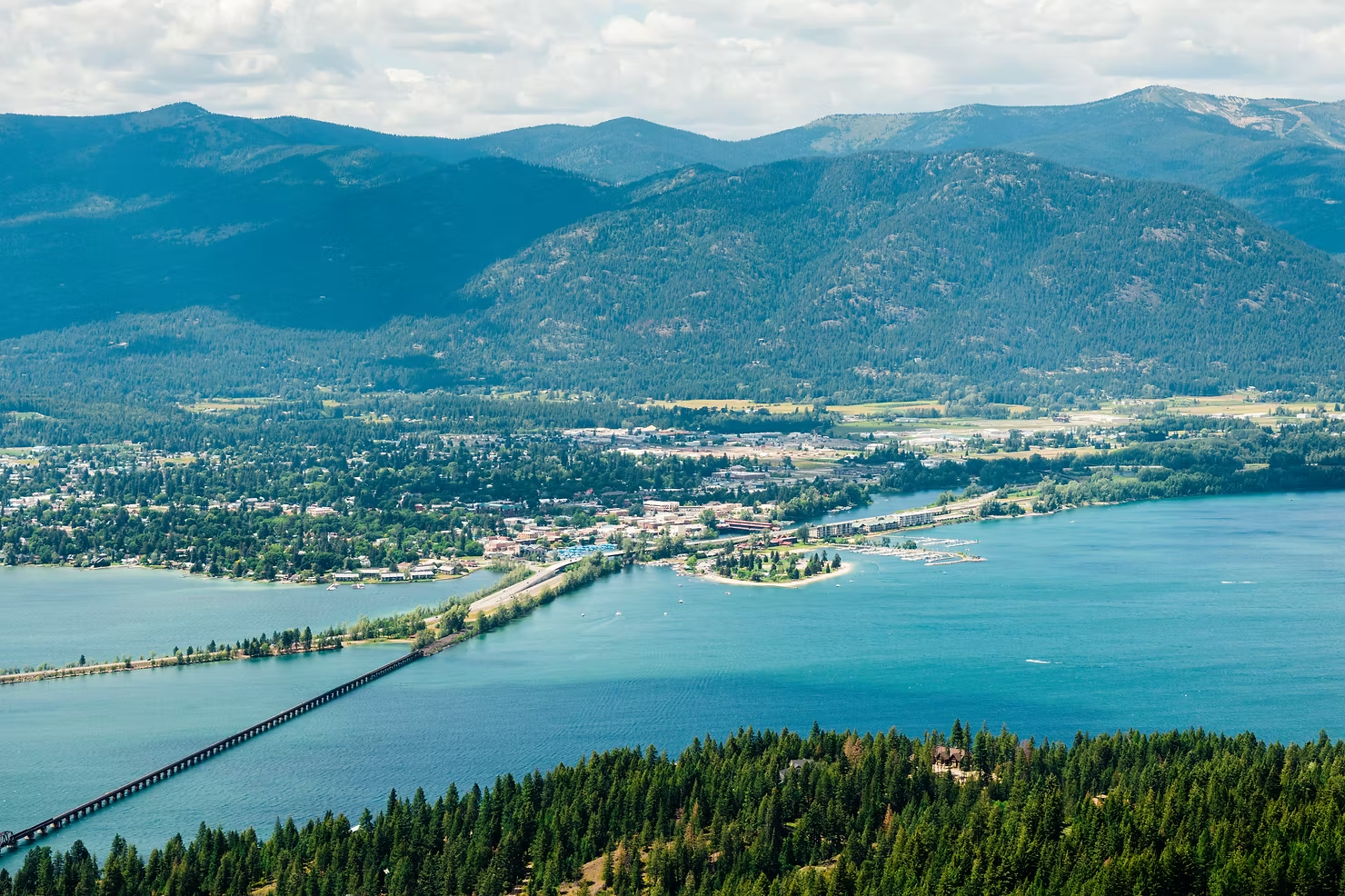
There are few places where geography has shaped a community quite like Sandpoint. Set along the shores of Lake Pend Oreille, framed by the Selkirk and Cabinet mountains and crossed by rail lines that have carried people and goods through North Idaho for generations, Sandpoint grew at a remarkable crossroads. The places we recognize today, from City Beach and the Panida Theatre to Schweitzer, each preserve a chapter of a story shaped by water, rails, mountains and the people who made this place home.
Before There Was A Sandpoint
Long before Sandpoint had a name, Lake Pend Oreille and the surrounding landscape were home to Indigenous peoples who traveled, hunted, fished and gathered throughout the region. The lake itself, one of the largest and deepest freshwater lakes in the United States, would eventually become one of the defining features of the community that developed along its northern shore.
European exploration and the fur trade brought newcomers into the region, followed later by prospectors, settlers and railroad crews. The name Pend Oreille has French origins and became attached to the lake, river and surrounding region.
But the Sandpoint we recognize today did not simply grow around a scenic lake. Its location became especially valuable because of transportation.
Where The Rails Met The Lake
The railroad was instrumental in turning Sandpoint from a remote settlement into a connected community.
Northern transcontinental rail development reached the region in the late 19th century, bringing workers, commerce and new residents. Sandpoint’s position near Lake Pend Oreille made it an important transportation point, and railroads would become deeply intertwined with the town’s identity.
As additional rail connections developed, Sandpoint became a place where major routes converged. Hotels, stores and other businesses followed the activity around the tracks, while the railroad connected the growing community with markets and cities far beyond North Idaho.
The importance of rail travel also brought some notable passengers through town.
Among them was President Theodore Roosevelt, whose travels through the West included a stop in Sandpoint. It is one of those wonderful pieces of local history that can be easy to overlook today: a sitting president arriving by train in a young North Idaho community, greeted by residents in a town that was still establishing its place on the map.
More than a century later, trains remain part of Sandpoint’s daily rhythm. Their whistles and the tracks crossing the community are reminders that the railroad is not simply part of Sandpoint’s past. It helped determine where the town grew and remains part of its character today.

Theodore Roosevelt In Sandpoint
1888: An unexpected first visit
Long before he entered the White House, 29-year-old Theodore Roosevelt passed through the frontier settlement of Sandpoint, then known as the village of Pend d’Oreille, on his way to the Selkirk Mountains for a hunting expedition.1911: A Presidential return
Roosevelt returned as a former president, delivering public speeches and enjoying a steamboat excursion across Lake Pend Oreille aboard The Northern.1912: Back on the campaign trail
The following year, Roosevelt stopped briefly at the Sandpoint railroad depot during his famous “Bull Moose” presidential campaign.
Lake Pend Oreille: The Constant In Sandpoint’s Story
If the railroad connected Sandpoint to the wider world, Lake Pend Oreille gave the community its sense of place.
Stretching across a vast portion of North Idaho, the lake has influenced transportation, industry, recreation and daily life for generations. Its shoreline and waterways supported people long before the establishment of Sandpoint, and as the town developed, the lake remained at the center of its identity.
Over time, the relationship between the community and the waterfront changed. What was once important primarily for transportation and industry increasingly became valued for recreation and access to the outdoors.
Today, boating, fishing, paddling and days spent along the shoreline are inseparable from the Sandpoint experience. Yet the lake is much more than a backdrop. It is one of the reasons this community exists where it does and a natural landmark connecting Sandpoint’s earliest history with life here today.
City Beach: From Transportation Hub To Community Gathering Place
Few places demonstrate Sandpoint’s relationship with Lake Pend Oreille better than City Beach.
The peninsula extending into the lake has become one of the community’s most familiar gathering places. Today, its beaches, lawns and views make it easy to think of the waterfront solely as a place for summer recreation.
Historically, however, Sandpoint’s shoreline was closely tied to the transportation and commercial activity that helped the town develop. Rail lines, bridges, docks and waterfront businesses all played roles in the evolving community.
As Sandpoint changed, so did the way residents interacted with the lake. Public recreation became an increasingly important part of the waterfront, and City Beach emerged as a place where the community could gather beside the water that had shaped its history.
On a summer afternoon, with families swimming and boats crossing the lake, it is a very different scene from Sandpoint’s early railroad years. But the reason people are drawn there remains remarkably similar: Lake Pend Oreille continues to be at the heart of life in Sandpoint.
The Panida Theatre: A Stage For The Community
By the 1920s, Sandpoint was becoming more than a railroad town. Downtown had developed into a center of commerce and community life, and in 1927, a new theater opened its doors.
The Panida Theatre became one of Sandpoint’s most distinctive landmarks.
Even its name tells a regional story. “Panida” was created by combining portions of the words “Panhandle” and “Idaho” giving the theater an identity firmly connected to its North Idaho home.
Designed during the grand era of American movie palaces, the theater offered Sandpoint audiences a place to experience films and live entertainment in an elegant setting. Over the decades, the Panida became much more than a building where movies were shown. It became part of the cultural memory of downtown.
Like many historic theaters, the Panida faced periods of uncertainty as entertainment habits and downtown districts changed. Community preservation efforts helped ensure that it survived.
Nearly a century after opening, its marquee still lights downtown Sandpoint. Concerts, films, performances and community events continue to bring audiences through its doors, allowing the Panida to serve much the same purpose it did generations ago: giving Sandpoint a place to gather.
Schweitzer: A Mountain Becomes A Destination
Look northwest from Sandpoint and another defining piece of the area’s identity rises above the lake.
Schweitzer’s story began not as a polished destination resort, but with a group of local residents who saw possibility in the mountain.
In the early 1960s, community members worked to establish a ski area on Schweitzer Mountain. The effort required vision, investment and plenty of determination.
What began as a locally driven idea gradually developed into one of the Northwest’s best-known mountain destinations.
For generations of Sandpoint families, Schweitzer became part of growing up in North Idaho. Winter weekends meant skis, chairlifts and snowy drives up the mountain. As the ski area expanded, new lifts, terrain, lodging and amenities followed.
Its identity also expanded beyond winter. Hiking, mountain biking, events and warm-weather recreation have helped turn Schweitzer into a year-round destination.
Yet its connection to Sandpoint remains an important part of its story. Long before visitors arrived from around the country, the mountain was a local dream built by people who believed their hometown could support something extraordinary.
Today, the view from Schweitzer brings the entire story into perspective. Far below lies Lake Pend Oreille, with Sandpoint tucked against its shore and railroad tracks still crossing the landscape.
A Town Shaped By Its Surroundings
Sandpoint’s history is not contained within any single building, park or landmark. It can be found in the relationship between all of them.
The lake provided a natural gathering point. The railroad connected a remote North Idaho settlement to the rest of the country. Downtown grew alongside those connections, eventually giving the community enduring landmarks like the Panida Theatre. City Beach transformed part of the waterfront into a gathering place for new generations. High above town, Schweitzer turned a local mountain into another defining part of Sandpoint life.
And through all of that change, the essential landscape has remained.
Stand on City Beach and look across Lake Pend Oreille. Hear a train passing behind downtown. Walk beneath the Panida’s marquee on a Friday evening. Or ride high above the lake at Schweitzer and look back toward town.
Each offers a different view of Sandpoint, but together they tell the same story: a community shaped by the remarkable place where the rails, the lake and the mountains meet.